
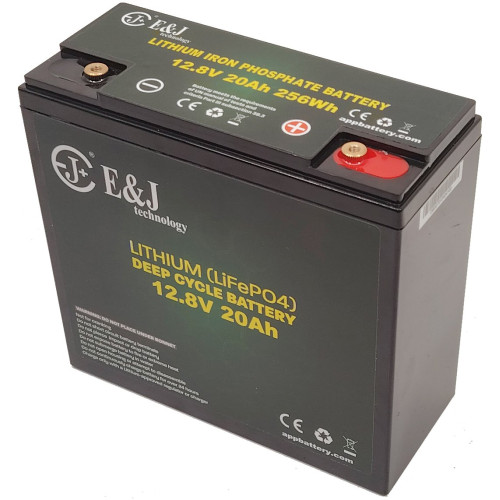
E&J Lithium 12V 20Ah
€171.40 per EJ1220
- For large quantities - ask for quotation
- sales@etronix.se
- BrandE&J
Description
Article no.: BAT-EJ1220
E&J Lithium 12,8V 20Ah LiFePO4. The areas of use are many, such as golf carts, electric motors, etc. The powerful BMS can handle 25A continuous discharge and 60A for 3 seconds, which means that the battery can handle a continuous load of 256W. The battery can be connected in parallel.
Specifications:
Power supply: 12.8 Volt
Capacity: 20Ah
Nominal energy: 256W
Max charging current: 15A
Recommended charging voltage: 14.5-14.7V
Recommended float charge: 13.6-13.8
Continuous power consumption: 25A
Peak power consumption: 60A for 3 seconds
Cycles: 100% discharged: approx 2000 cycles.
Operating temperature: -20 °C to 60 °C
Discharge temperature: -20 °C to 60 °C
Charging temperature: 0 °C to 45 °C
Storage temperature: 0 °C to 40 °C
Recommended storage temperature: 15 °C to 30 °C
Storage:
Parallel connection:
The battery can be connected in parallel. Charge the batteries separately and fully with an external charger, there must be a maximum difference of 0.2v between the batteries before parallel connection.
Generator:
Lithium batteries require compatible components. Use a Victron DC-DC or Wakespeed regulator to protect the generator and optimize charging.
Battery Charger:
Use a charger specifically for lithium batteries. Make sure the charger does not have "Desulfation" or "Equalize charge" which can raise the voltage to 15-16V.
Solar cell controller:
Victron MPPT is recommended for optimal charging. If the regulator is not adapted for lithium, please ensure that it can be adjusted to the correct settings.
Steps for long term storage of Lithium Battery:
1. Charge the Battery to 100%
Before storing your motorhome or caravan for the winter, make sure to fully charge the battery. This will ensure that the battery is ready to withstand a longer period without charging and that the cells are in balance. Leave the charger on for an extra couple of hours after a full charge.
2. Charge Out to 80%
For long term storage it is recommended that the battery is kept at approximately 80% charge. This will reduce the stress on the battery cells.
3. Disconnect the Battery
Use a battery disconnector or disconnect the negative terminal of the battery to avoid standby consumption from electronic systems that can drain the battery over time. Even though many motorhomes and campervans have master switches, smaller users can still draw power if the battery is not fully disconnected.
4. Charge after three months
Fully charge the battery and then discharge the battery to about 80%.
5. Charging after Winter Storage
When winter is over and you are going to use the battery again, fully charge it to 14.4-14.6V to balance the cells and restore the full capacity of the battery. It may require 1-3 charging cycles for the cells to balance correctly.
Specifications:
Power supply: 12.8 Volt
Capacity: 20Ah
Nominal energy: 256W
Max charging current: 15A
Recommended charging voltage: 14.5-14.7V
Recommended float charge: 13.6-13.8
Continuous power consumption: 25A
Peak power consumption: 60A for 3 seconds
Cycles: 100% discharged: approx 2000 cycles.
Operating temperature: -20 °C to 60 °C
Discharge temperature: -20 °C to 60 °C
Charging temperature: 0 °C to 45 °C
Storage temperature: 0 °C to 40 °C
Recommended storage temperature: 15 °C to 30 °C
Storage:
Parallel connection:
The battery can be connected in parallel. Charge the batteries separately and fully with an external charger, there must be a maximum difference of 0.2v between the batteries before parallel connection.
Generator:
Lithium batteries require compatible components. Use a Victron DC-DC or Wakespeed regulator to protect the generator and optimize charging.
Battery Charger:
Use a charger specifically for lithium batteries. Make sure the charger does not have "Desulfation" or "Equalize charge" which can raise the voltage to 15-16V.
Solar cell controller:
Victron MPPT is recommended for optimal charging. If the regulator is not adapted for lithium, please ensure that it can be adjusted to the correct settings.
Steps for long term storage of Lithium Battery:
1. Charge the Battery to 100%
Before storing your motorhome or caravan for the winter, make sure to fully charge the battery. This will ensure that the battery is ready to withstand a longer period without charging and that the cells are in balance. Leave the charger on for an extra couple of hours after a full charge.
2. Charge Out to 80%
For long term storage it is recommended that the battery is kept at approximately 80% charge. This will reduce the stress on the battery cells.
3. Disconnect the Battery
Use a battery disconnector or disconnect the negative terminal of the battery to avoid standby consumption from electronic systems that can drain the battery over time. Even though many motorhomes and campervans have master switches, smaller users can still draw power if the battery is not fully disconnected.
4. Charge after three months
Fully charge the battery and then discharge the battery to about 80%.
5. Charging after Winter Storage
When winter is over and you are going to use the battery again, fully charge it to 14.4-14.6V to balance the cells and restore the full capacity of the battery. It may require 1-3 charging cycles for the cells to balance correctly.