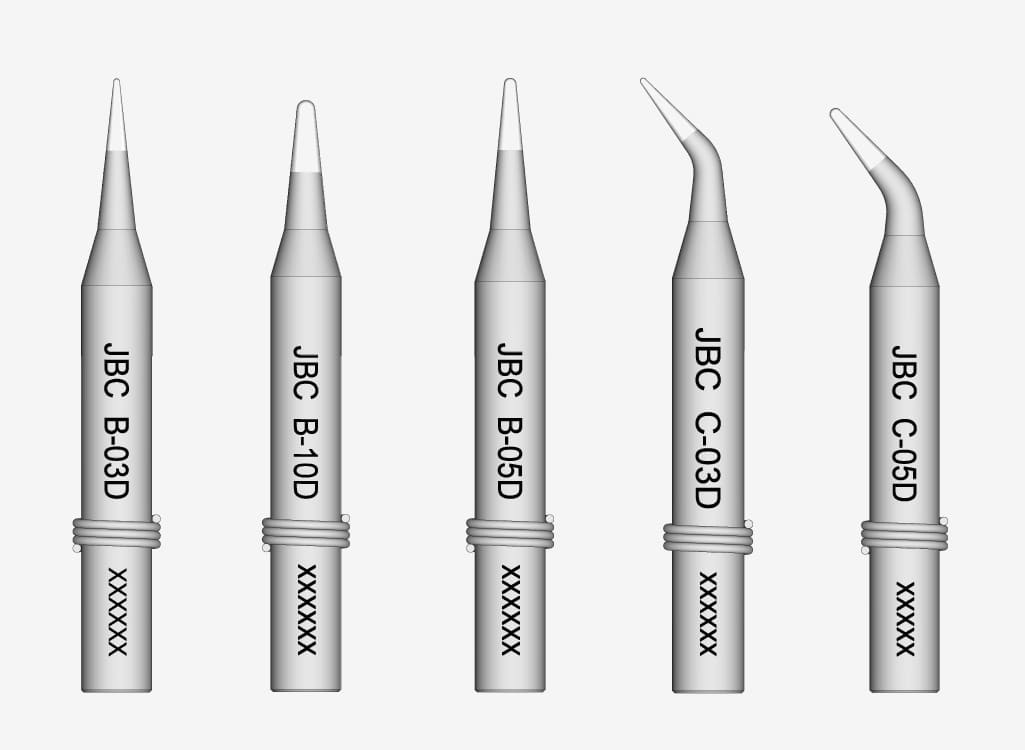
8 tips on how to use and care for your JBC soldering tip
When the lead-free regulations came into force in 2006, more and more people have realized that a JBC soldering station is a good choice of stations to invest in. The range includes single stations, double stations, quattro stations and a number of different repair systems. Of course, all units have a digital display and have automatic shut-off/rest temp when the pen is put in its place. The most common pen called T245 has a rated power of 50W and gives the tips a peak power of 140W. Within 4-6 sec you reach the set value. The faster the pen, the faster the recovery time, the temperature losses are minimized and the pen never "feels" difficult to solder with.
A good feature of JBC stations is that you do not have to physically touch the tip when replacing it. It automatically goes to sleep/shutdown when you are not working with it. This prolongs the life of a soldering tip.
(The following recommendation applies to JBC soldering tips)
Here are 8 tips on how to both use and care for your JBC soldering tips
1. Choose the right tip for the job
JBC has a wide range that covers most needs. JBC has developed a basic range of the most frequented tips and introduced a 10 pack price. Always choose a tip with regard to the nature and size of the soldering iron. The risk of cold brazing and damage to components and conductors is reduced. Select as large a tip as possible as the application requires. A large contact surface/mass is an advantage regarding lead-free.
2. Select the correct temperature for the job
The soldering tool must have sufficient heat content and power to be able to quickly heat the soldering point to approx. 50°C above the melting temperature of the solder. Always choose a slightly lower temperature first. A JBC soldering iron has fast heating, even temperature maintenance and it recovers extremely quickly during serial soldering. Recommended peak temperature for lead-free is 320-340°C.
3. Correct angle and press the soldering point
Adjust the angle of the tip towards the soldering iron and never press too hard. Do not use the tip as a screwdriver or scrape with it. The plating of the tip will then crack and become unusable. JBC soldering tips have a lifetime guarantee on the heating element, provided that the plating is intact and the tips have not been used incorrectly.
4. Leave solder on the tip
Feed on a few millimeters of solder. This prevents oxidation of the tips. The oxidation otherwise shortens the life of the tips and impairs the wettable surface. Wipe the tinned part of the tip before soldering, not after. When you use brass wool, you preserve more tin on the tip, which reduces oxidation. When you have finished soldering with the tip and will not use the tip for a while, make sure that you wet the tip thoroughly with solder before you put the pen back.
5. Clean and change sponges often
The sponge should not be dry or too wet, but just moist. A too wet sponge exposes the tip to severe thermal stress, this leads to microcracks in the tip's outer casing, which shortens the tip's life. Wash out the sponge in ordinary tap water, preferably every day, and then use detergent. Squeeze the sponge dry after cleaning. Align the tinned surface of the tip with the holes in the sponge and slowly wipe off the excess stone.
6. Use distilled water for the mushroom
Tap water contains minerals and provides deposits on sponges and tips. Make a habit of using distilled or deionized water for refilling.
7. Use brass wool
Dry cleaning of the tips avoids thermal stress that can result in microcracks. In addition, you avoid making the tip too clean, which is easily the case with sponges. Spare wool is available as an article.
8. Carefully re-tincture the tip
The tip toner is a lead-free aid with which you oxidize and re-wet the tips. Doing this regularly will extend the life of the tips. Then wipe the tip thoroughly with the sponge and re-tinned with ordinary solder before starting new soldering. Insert the soldering tip at a 45 ° angle and rotate slowly until the entire tip is covered with tin. Then wipe the tip against the slightly dampened sponge or brass wool before soldering. Then wipe the tip thoroughly before starting new soldering.
In other words, use the product sparingly at most once a day to ensure that its lifespan does not decrease so dramatically.
|



