
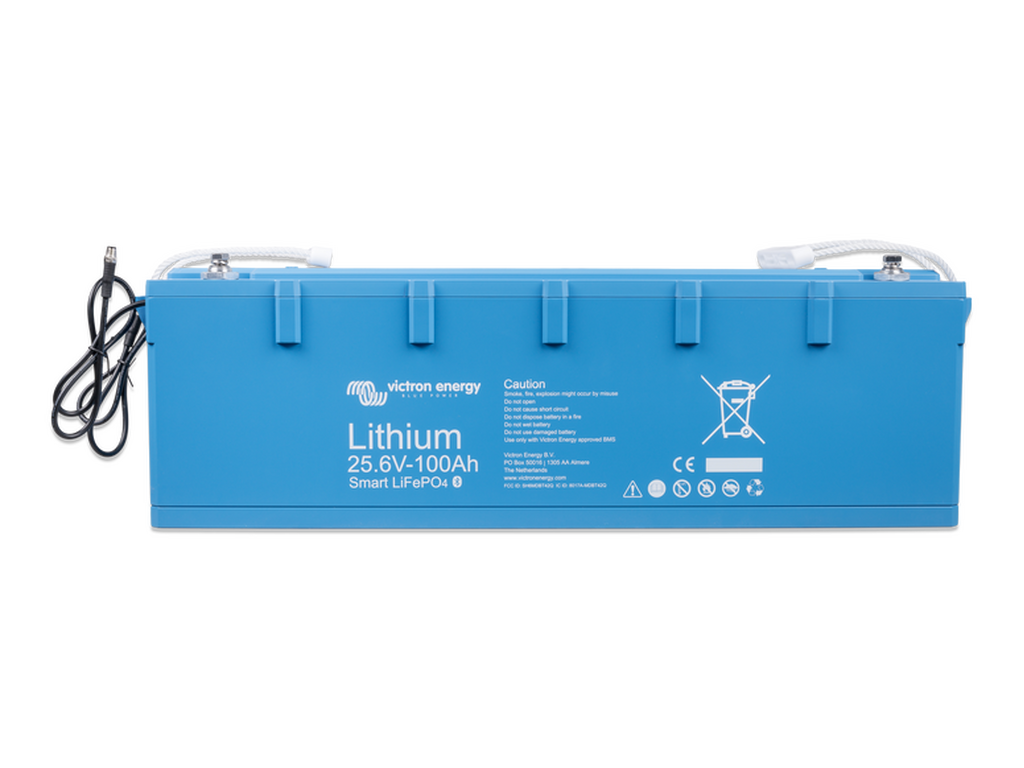
Victron Lithium Smart 25.6V 100Ah
€1,340.20 per styck
Victron Smart Lithium has integrated cell balance and cell monitoring systems
- For large quantities - ask for quotation
- sales@etronix.se
- Amps100
- Art no10-0592
- Battery typeFörbrukningsbatteri
- BrandVICTRON
- Height197
- IP classIP22
- Length631
- SKUBAT524110610
- Volt25.6V
- Width163
Description
Article no.: 10-0592
Victron Smart Lithium has integrated cell balance and cell monitoring systems. Up to 5 batteries can be connected in parallel and up to four 12 V batteries or two 24 V batteries can be connected in series to form a 48 V battery bank of up to 1500 Ah. The cell balance/monitoring cables can be daisy-chained and must be connected to the Battery Management System (BMS). Battery Management System (BMS) Victron smart lithium must be connected to one of these BMS units: VE.Bus BMS is recommended for systems with our inverters/chargers. smallBMS is recommended for use in small systems. Battery Management System BMS 12/200 is recommended for use in automotive and marine systems with DC loads and alternators. Smart BMS CL 12/100 is recommended for use in automotive and marine systems with DC loads and alternators. Why lithium iron phosphate? Lithium iron phosphate (LiFePO4 or LFP) is the safest of the common Li-ion battery types. The normal voltage in an LFP cell is 3.2V (lead-acid: 2V/cell). A 12,8V LFP battery therefore consists of 4 cells connected in series and a 25,6V battery consists of 8 cells also connected in series. Robust A lead-acid battery will degrade due to sulphatization. It will operate in deficit mode for long periods of time (i.e. if the battery is rarely or never fully charged). If it is left partially charged or, even worse, completely discharged (in a boat or in a caravan during winter). An LFP battery does not need to be fully charged. In fact, operating life is improved if it is partially charged instead of fully charged. This is a major advantage of an LFP over a lead-acid battery. Other benefits include wide operating temperature ranges, excellent cycling performance, low internal resistance and high efficiency (see below). LFP is therefore the chemical choice for demanding applications. Efficient In several applications (especially off-grid solar and/or wind installations), energy efficiency can be crucial. The round-trip efficiency (discharge from 100% to 0% and back to 100% charge) of the average lead-acid battery is 80%. The equivalent for an LFP battery is 92%. The charging process of lead-acid batteries becomes particularly inefficient once the 80% state of charge has been reached, resulting in 50% efficiency or even less in solar systems where several days of reserve energy are required (battery life in 70% to 100% charged state). In contrast, an LFP battery will still achieve 90% efficiency under shallow discharge conditions. Size and weight Save up to 70% in space Save up to 70% in weight Expensive? LFP batteries are expensive compared to lead-acid. But in demanding applications, the high initial cost will be more than offset by longer operating life, superior reliability and excellent efficiency. Bluetooth Bluetooth allows cell voltage, temperature and alarm status to be checked. This is very useful for localizing (potential) problems such as cell imbalance.